Publish Date
Social Handle


South Florida's restaurant scene is booming. Fort Lauderdale earned its first Michelin star in 2026, Miami's dining scene is tighter than ever with a new Top 50 list replacing the old Top 100, and new openings are stretching from Las Olas to Wynwood to Boca Raton at a pace that's hard to keep up with. Waterfront restaurants with sprawling patios, rooftop lounges, poolside bars, and open-air dining rooms are everywhere — because in South Florida, outdoor dining isn't seasonal. It's year-round.
And if you're printing menus for any of them, you already know the problem. Florida's humidity, daily rain showers, salt air near the coast, and the relentless cycle of spills, sanitizing wipes, and sticky hands will destroy the wrong menu in weeks. That crisp, glossy menu that looked perfect on opening night? Six months in and it's warped, peeling, smudged, and screaming that this restaurant hasn't updated its materials since the pandemic.
The good news: the right materials make a dramatic difference. A well-specified menu printed on the right stock with the right finish will survive Miami's climate for 12–24 months or longer — saving you reprinting costs, reducing waste, and keeping your front-of-house materials looking as sharp in month twelve as they did on day one. Here's exactly what to use and why.
Why Florida's Climate Is So Hard on Restaurant Menus
Most menu printing guides are written for generic American restaurant conditions. South Florida is not generic. Here's what your menus are actually up against in Miami, Fort Lauderdale, Hollywood, and Boca Raton:
Humidity above 75% for most of the year. South Florida's ambient humidity doesn't just affect outdoor menus — it seeps into indoor dining rooms too, especially in restaurants near the water. Paper fibers absorb moisture, swell, and warp. Laminate adhesives weaken. Unprotected menus curl at the corners, bubble at the edges, and lose their rigidity within weeks.
Daily afternoon rain. South Florida's predictable summer rain pattern means outdoor and patio menus get wet. Not occasionally — regularly. Even a brief afternoon shower can soak a table of unprotected menus. For waterfront restaurants from Coconut Grove to Fort Lauderdale Beach, this is a near-daily reality from May through October.
Salt air in coastal locations. Restaurants within a mile or two of the ocean — South Beach, Fort Lauderdale beach strip, Deerfield Beach, Boca Raton oceanfront — deal with salt-laden air that accelerates the degradation of paper, adhesives, and laminate coatings. Salt air is particularly brutal on laminate edge seals, causing premature peeling that lets moisture wick into the menu core.
Spills, sanitizing, and heavy handling. Restaurant menus are handled dozens of times per day by guests and staff, wiped down between covers with sanitizing solutions, and occasionally subjected to full liquid spills. In a high-volume Miami or Fort Lauderdale restaurant turning 200 covers a night, a menu experiences more physical stress in one month than most printed materials see in a year.
The printed menu comeback. Miami dining trend reports confirm that QR code menus are fading, with restaurateurs recognizing that diners prefer printed menus — especially in upscale and fine dining environments. More printed menus means more menus in circulation, more handling, and more exposure to all of the above.
The Real Cost of Getting This Wrong A restaurant serving 150 covers per night with 30 menus in rotation is replacing those menus every 3–4 months if they're printed on standard uncoated or lightly coated stock. At $3–5 per menu, that's $90–$150 every quarter — $360–$600 per year — just to keep menus presentable. The right material choice typically costs 20–40% more upfront but lasts 3–4x longer, cutting annual menu spend by more than half. |
Menu Materials: What Actually Lasts in South Florida
1. Gloss UV Laminate on 14–16pt Card Stock — The Workhorse for Indoor Dining
For the majority of South Florida restaurants serving indoor dine-in covers, gloss UV lamination on 14–16pt card stock is the standard recommendation. Here's why:
The UV laminate creates a hard, sealed surface layer that resists moisture penetration, spills, and sanitizing wipe-downs. Laminated menus can withstand 500+ fold cycles without delamination, and the gloss finish enhances color vibrancy — making food photography and design elements look sharper and more appetizing than matte or uncoated alternatives.
The 16pt card stock provides enough rigidity to prevent the warping and curling that thinner stocks develop in humid conditions. In South Florida's indoor restaurant environments — where air conditioning creates daily humidity swings between the conditioned interior and the humid exterior — that rigidity is what keeps menus lying flat on the table instead of curling like a cinnamon roll.
Typical lifespan in South Florida: 12–18 months with regular cleaning and normal handling. Best for: high-volume casual dining, upscale casual, and fine dining with indoor-only service.
2. Soft-Touch Laminate on 16pt Stock — For Upscale and Fine Dining
Soft-touch laminate has become the premium choice for South Florida's upscale restaurant segment — the Brickell steakhouses, the Las Olas fine dining rooms, the Boca Raton establishments where the menu is as much a brand statement as it is a list of dishes. The velvety, matte texture mimics premium silk while adding meaningful water resistance and durability.
The trade-off versus gloss UV is a slightly lower resistance to moisture penetration at the surface — soft-touch laminates are not as impervious to prolonged liquid contact as gloss. But for fine dining environments where menus are handled with more care and replaced at longer intervals, soft-touch laminate on 16pt stock is the most premium-feeling, brand-appropriate option available.
Typical lifespan in South Florida: 12–18 months indoors. Best for: fine dining, luxury casual, tasting menu restaurants, and any concept where tactile brand experience is part of the hospitality.
3. Sealed-Edge Lamination — Maximum Humidity and Spill Resistance
Standard lamination has an Achilles heel in South Florida: the edges. When laminate is trimmed flush to the menu edge, moisture can wick into the paper core from the cut edge — especially in humid or spill-prone environments. Over time, this causes the internal paper to swell, bubble, and eventually delaminate from the inside out.
Sealed-edge lamination — also called edge-seal or fully-encapsulated lamination — solves this by extending the laminate film slightly beyond the menu edge, creating a complete moisture seal around all four sides. This edge seal prevents moisture wicking from the table surface, dramatically extending menu life in high-humidity environments.
For South Florida bars, high-top tables, outdoor-adjacent dining areas, and any restaurant where menus regularly sit on wet or damp surfaces, sealed-edge lamination is worth the modest additional cost.
Typical lifespan in South Florida: 18–24 months with regular handling. Best for: bars, casual dining, high-volume restaurants, any setting with frequent spills or surface moisture.
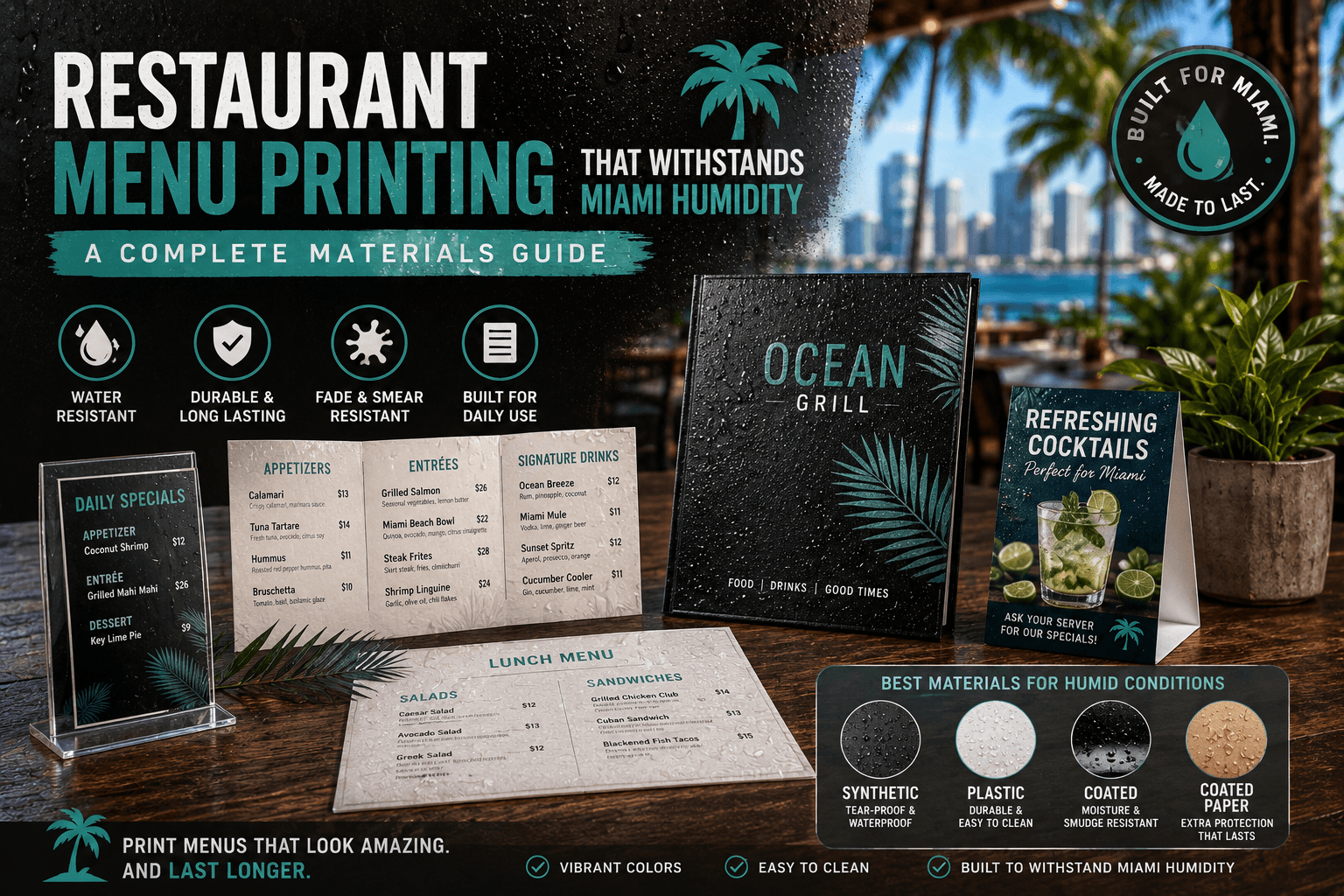
4. Synthetic / Waterproof Paper — The Gold Standard for Outdoor and Waterfront Dining
For South Florida's waterfront restaurants, pool bars, rooftop lounges, beach clubs, and patio dining areas, no laminated paper menu will survive the combination of direct moisture exposure, salt air, and full liquid immersion. The solution is a different material entirely: synthetic waterproof paper.
Synthetic menus are made from a plastic-based substrate that is 100% waterproof, tearproof, and stain-resistant — by construction, not by coating. There is no laminate to peel, no edge seal to fail, no paper core to absorb moisture. A synthetic menu can be submerged, wiped down with sanitizing chemicals, and dried without damage. With proper care, synthetic menus last 2–3 years of daily use — compared to 6–12 months for laminated menus in comparable outdoor conditions.
For Fort Lauderdale's Intracoastal waterfront restaurants, Miami Beach oceanfront dining rooms, and any Boca Raton or Hollywood patio concept where menus face weather, spray, and the full South Florida outdoor experience, synthetic is the only material that makes economic and operational sense.
Typical lifespan in South Florida: 2–3 years outdoors, longer indoors. Best for: outdoor patio dining, waterfront restaurants, pool bars, beach clubs, tiki bars, and any concept with significant outdoor cover counts.
5. Aqueous Coating on 14pt — Budget-Friendly for Lower-Traffic Use
Aqueous coating is a water-based protective finish applied during printing that provides a moderate level of moisture and scuff resistance without the thickness or cost of lamination. It's the most affordable protective option and works reasonably well in low-humidity indoor environments with light handling.
The limitation in South Florida: aqueous coating is not lamination. In high-humidity environments, it provides limited protection against warping and moisture absorption compared to laminated options. For a restaurant in Brickell or Wynwood where menus stay indoors, see moderate handling, and get updated seasonally anyway, aqueous coating on 14pt is a cost-effective choice. For anywhere near the water or with outdoor service, upgrade to laminated or synthetic.
Typical lifespan in South Florida: 3–6 months indoors with regular handling. Best for: seasonal specials inserts, budget-conscious concepts, menus updated frequently.
6. Digital On-Demand for Inserts and Seasonal Specials
Not every piece of paper at a restaurant table needs to be a durable, long-life menu. Daily specials boards, seasonal cocktail lists, prix fixe inserts, and table tent promotions are meant to be updated frequently — and for these, digital on-demand printing on coated card stock is the smart choice. Print what you need, when you need it, in small quantities, without the cost of lamination on a piece that'll be obsolete in two weeks.
For South Florida restaurants updating seasonal menus, introducing limited-time offerings, or running event-specific promotions, on-demand digital printing gives you the flexibility to keep materials fresh without the waste of a large offset run.
Quick Reference: Menu Materials for South Florida Restaurants
Material | Humidity Resistance | Lifespan (FL) | Best Setting | Ideal For |
Gloss UV Laminate (14–16pt) | Excellent | 12–18 months | Indoor dine-in | High-volume casual to upscale dining |
Soft-Touch Laminate (16pt) | Very Good | 12–18 months | Indoor fine dining | Upscale restaurants, luxury branding |
Sealed-Edge Lamination | Excellent | 18–24 months | Indoor / bar tops | High-traffic, spill-prone environments |
Synthetic / Waterproof Paper | 100% Waterproof | 2–3 years | Outdoor / waterfront | Patio, pool bar, waterfront dining |
Aqueous Coating (14pt) | Moderate | 3–6 months | Indoor low-traffic | Budget menus, seasonal inserts |
Digital On-Demand (uncoated) | Low | Weeks to months | Indoor only | Seasonal specials, QR supplement cards |
Choosing the Right Menu Format for South Florida Dining Concepts
Material is one half of the menu printing decision. Format is the other. Here's how to think about menu format for South Florida's most common dining concepts:
Fine Dining and Upscale Casual (Brickell, Coral Gables, Las Olas, Boca Raton)
Soft-touch laminated single-panel or bi-fold menus on 16pt card stock. Clean, minimal design with generous white space. The menu as a brand statement — the stock, the finish, and the weight in the hand should communicate the same level of care as the food. Size: 5.5" x 8.5" or 8.5" x 11" single panels are the current standard in South Florida fine dining.
High-Volume Casual Dining (Wynwood, Downtown Miami, Fort Lauderdale Beach)
Gloss UV laminated 4-panel or 6-panel menus on 14–16pt card stock with sealed edges. Designed to survive heavy rotation, frequent wipe-downs, and the physical chaos of a busy Friday night. Size: 8.5" x 11" or 8.5" x 14" multi-panel, saddle-stitched or wire-coil bound for durability.
Waterfront, Patio & Outdoor Dining (Intracoastal, Ocean Drive, Marina Locations)
Synthetic waterproof paper. No exceptions. The climate will destroy laminated menus in this environment within months, regardless of quality. Size: 8.5" x 11" single or bi-fold on 11–14 mil synthetic stock. Consider weighted menu covers to prevent wind from scattering menus on exposed outdoor terraces.
Bars, Cocktail Lounges & High-Tops (Miami Beach, Fort Lauderdale Nightlife)
Sealed-edge lamination on 16pt card stock, or synthetic if the bar environment involves significant moisture exposure. Cocktail menus: 4" x 9" or 5" x 7" single panel are the current standard — compact enough for high-top use, substantial enough to feel premium.
Fast Casual, Food Halls & QSR (Doral, Sunrise, Plantation)
For fast casual concepts updating menus frequently, digital on-demand printing on aqueous-coated 14pt gives the right balance of quality and cost-efficiency. Accept shorter lifespans in exchange for the flexibility to update pricing, items, and seasonal offerings without being locked into a large print run.
One More Thing: The Printed Menu Comeback Is Real Miami dining writers confirmed in 2026 that QR code menus are on their way out, with restaurateurs switching back to printed menus as diners make clear they prefer them — especially in upscale environments. If you paused printed menu investment during the QR code era, now is the time to reinvest. The format that defines your dining experience is back, and your competitors are upgrading theirs. |
What to Tell Your Printer: A South Florida Restaurant Checklist
When ordering menus for a South Florida restaurant, these are the specifications that matter:
Stock weight: 14pt minimum for any laminated menu; 16pt for fine dining or soft-touch applications
Laminate type: Gloss UV for durability and vibrancy; soft-touch for premium feel; specify sealed-edge for high-moisture environments
Synthetic for outdoor: Any outdoor, waterfront, or patio application should specify synthetic/waterproof substrate — not laminated paper
Rounded corners: Rounded corners resist peeling and chipping significantly better than square corners in humid, high-handling environments
Inks: Confirm UV-stable or food-safe inks for any menu — especially important for surfaces that will be wiped with sanitizing solutions
Quantity: For a restaurant seating 100 covers, a starting quantity of 30–40 menus gives enough rotation buffer for one menu per table plus extras for wear. Scale accordingly
Update cycle: Plan your reprint schedule before you run out. Building a 3-month or 6-month reprint into your operating calendar prevents the scramble of printing emergency replacements at rush pricing.
Get South Florida's Best Restaurant Menu Printing at MOR Printing
At MOR Printing, we've been producing restaurant menus for South Florida dining concepts for over 36 years. We know what survives a Fort Lauderdale patio. We know what holds up through a Saturday night at a 200-cover Brickell restaurant. We know which laminates, stocks, and finishes perform in this climate — because we've watched them perform and fail for decades.
From waterproof synthetic menus for Miami's waterfront restaurants to soft-touch laminated fine dining menus for Boca Raton's upscale concepts to sealed-edge laminated dine-in menus for high-volume Fort Lauderdale restaurants, we produce every format, finish, and stock at our 60,000-square-foot Plantation facility — with fast turnaround times and color consistency that keeps your brand looking sharp from the first cover to the last.
Get a free quote at morprinting.com — and let's make sure your menus survive whatever South Florida throws at them.


