Publish Date
Social Handle


Every South Florida business owner has heard some version of the same argument over the past decade: digital is everything. Social media, email, Google ads, SEO — the marketing conversation has been dominated by screens and algorithms for so long that print marketing has been quietly written off by many businesses as a relic.
The data tells a very different story.
In 2026, direct mail generates 161% ROI — compared to 44% for email and 23% for paid search. The average direct mail response rate is 37 times higher than email. And 84% of marketers say print provides their highest ROI of any channel they use. These aren't numbers from a printing industry advocacy group — they're from the ANA/DMA Response Rate Report, Lob's State of Direct Mail, and PostcardMania's analysis of over 115,000 leads.
So why does everyone keep saying digital is the only thing that matters? And what should South Florida businesses actually be doing with their marketing budget in 2026? That's what this post is about.
The State of Digital Marketing in 2026: What's Working and What Isn't
Digital marketing isn't going anywhere — and we're not here to argue that it should. But it's worth being honest about the challenges the digital landscape is presenting to South Florida businesses right now.
Digital Fatigue Is Real and Measurable
The average American is exposed to 4,000 to 10,000 digital ads per day. Email inboxes are overflowing. Social media feeds are algorithmically curated to minimize the reach of business content. Google ad costs have risen steadily year over year as more businesses compete for the same keywords. The result is a digital environment where standing out is harder and more expensive than it has ever been.
This isn't speculation — it's reflected in the performance data. Email open rates have declined from historical averages of 20–25% to 15–18% for many industries. Social media organic reach for business pages has dropped to 2–5% of followers on most platforms. Display ad click-through rates average 0.1% — meaning 999 out of every 1,000 people who see a display ad don't click it.
Privacy Changes Have Undermined Digital Targeting
Apple's App Tracking Transparency, Google's deprecation of third-party cookies, and increasingly strict privacy regulations have significantly reduced the targeting precision that made digital advertising so effective a few years ago. 76% of marketing teams have reallocated budget from digital to direct mail specifically because of privacy-driven targeting limitations — because physical mail doesn't require cookies, pixel tracking, or third-party data to reach a specific household.
Algorithm Dependency Creates Unpredictability
A business that builds its entire marketing strategy on social media or paid search is one algorithm change away from a significant disruption. Facebook reach changes, Google ad auction dynamics, TikTok policy shifts — these are variables entirely outside a business's control. Print marketing has no algorithm. A postcard that enters a mailbox gets seen, period.
The Digital Crowding Problem in South Florida Miami, Fort Lauderdale, and Boca Raton are among the most competitive digital advertising markets in Florida. Cost-per-click rates for competitive South Florida keywords in real estate, healthcare, home services, and financial services regularly run $8–$35 per click — and those clicks don't guarantee conversions. A direct mail campaign reaching 1,000 targeted households in the same market costs a fraction of the equivalent paid search spend and generates a response rate that no digital channel can match. |
The Print Marketing Reality Check: What the Numbers Actually Show
Here's the data that most South Florida businesses haven't seen — because the loudest voices in marketing have a financial incentive to keep you spending on digital.
Direct Mail Response Rates vs. Every Digital Channel
According to the ANA/DMA Response Rate Report 2026, direct mail delivers a 4.4% average response rate — compared to 0.12% for email, 0.9% for social media, and 0.1% for display advertising. That means direct mail generates responses at a rate 37 times higher than email and more than 40 times higher than display advertising. For house lists (existing customers), response rates climb to 5–9%.
ROI That Outperforms Every Major Channel
The ROI comparison across marketing channels makes the case clearly: direct mail averages 161% ROI — compared to 44% for email, 23% for paid search, 21% for paid social, and 16% for display advertising. That's not a marginal advantage. Direct mail ROI beats email by 266% and outperforms display advertising by 600%.
Print Builds Trust That Digital Can't Replicate
82% of millennials trust print advertisements — the same generation that grew up on social media. 92% of millennials have made purchasing decisions based on direct mail. 63% of Gen Z report being more excited about direct mail than a year ago. The narrative that younger consumers only respond to digital is simply not supported by the data.
Print Reaches People When Digital Can't
When someone is driving past your signage, holding your menu, flipping through your brochure, or pulling your postcard out of their mailbox — they are not on a screen. They are not being competed for by 4,000 other advertisers. Your message has their physical attention in a way that no digital ad can achieve. That undivided attention is increasingly rare and increasingly valuable.
Channel Performance Comparison: Print vs. Digital in 2026
Channel | Avg Response Rate | Avg ROI | Biggest Strength |
Direct Mail | 4.4% | 161% | Highest engagement, trust, and response rate of any channel |
Email Marketing | 0.12% | 44% | Speed, low cost per send, automation |
Paid Search (PPC) | ~2–3% CTR | 23% | High purchase intent, immediate visibility |
Paid Social Media | ~0.9% CTR | 21% | Audience targeting, brand awareness at scale |
Display Advertising | ~0.1% CTR | 16% | Retargeting, visual brand awareness |
SEO / Organic Search | Varies | Highest long-term | Compounding traffic, zero cost per click, trust |
Print Advertising | ~2–3% | High (brand-dependent) | Credibility, permanence, brand authority |
Combined Print + Digital | Up to 9%+ | 400%+ vs digital alone | Maximum reach, trust, and conversion across channels |
Where Digital Marketing Still Wins
Acknowledging print's performance advantages doesn't mean ignoring digital's genuine strengths. The goal is a clear-eyed view of what each channel does best — not a false choice between them.
Speed and Immediacy
When you need to reach people right now — a flash sale starting in two hours, breaking news about your business, a time-sensitive event announcement — digital wins decisively. An email or social post reaches your audience instantly. Direct mail takes days. For truly time-sensitive communication, digital is the only viable choice.
Scalability and Reach
Running a national digital campaign is relatively straightforward. Reaching millions of people with a print campaign requires significantly more logistics, cost, and production time. For broad awareness campaigns targeting large audiences across many geographies simultaneously, digital platforms offer a scalability advantage that print can't practically match.
Micro-Targeting and Retargeting
Digital advertising's ability to target specific individuals based on their browsing behavior, purchase history, and online activity — and to retarget people who have already visited your website — remains a genuine capability that print cannot replicate. For businesses with complex sales funnels and significant online customer data, digital retargeting is a powerful tool.
Real-Time Analytics
Digital campaigns provide immediate performance data — impressions, clicks, conversions, and cost per acquisition in real time. Print campaigns produce results that are real and often superior, but measuring them requires more deliberate tracking mechanisms (QR codes, unique URLs, promo codes). The feedback loop in digital is faster, which makes iteration and optimization easier.
Low-Cost Entry Points
You can run a digital ad campaign for $5 a day. A direct mail campaign has a meaningful minimum production and postage cost. For businesses with very limited marketing budgets, digital's low entry point is a practical advantage — though the ROI comparison above suggests that the economics of direct mail often justify the higher upfront investment.
The Real Answer: It's Not Print vs. Digital — It's Print AND Digital
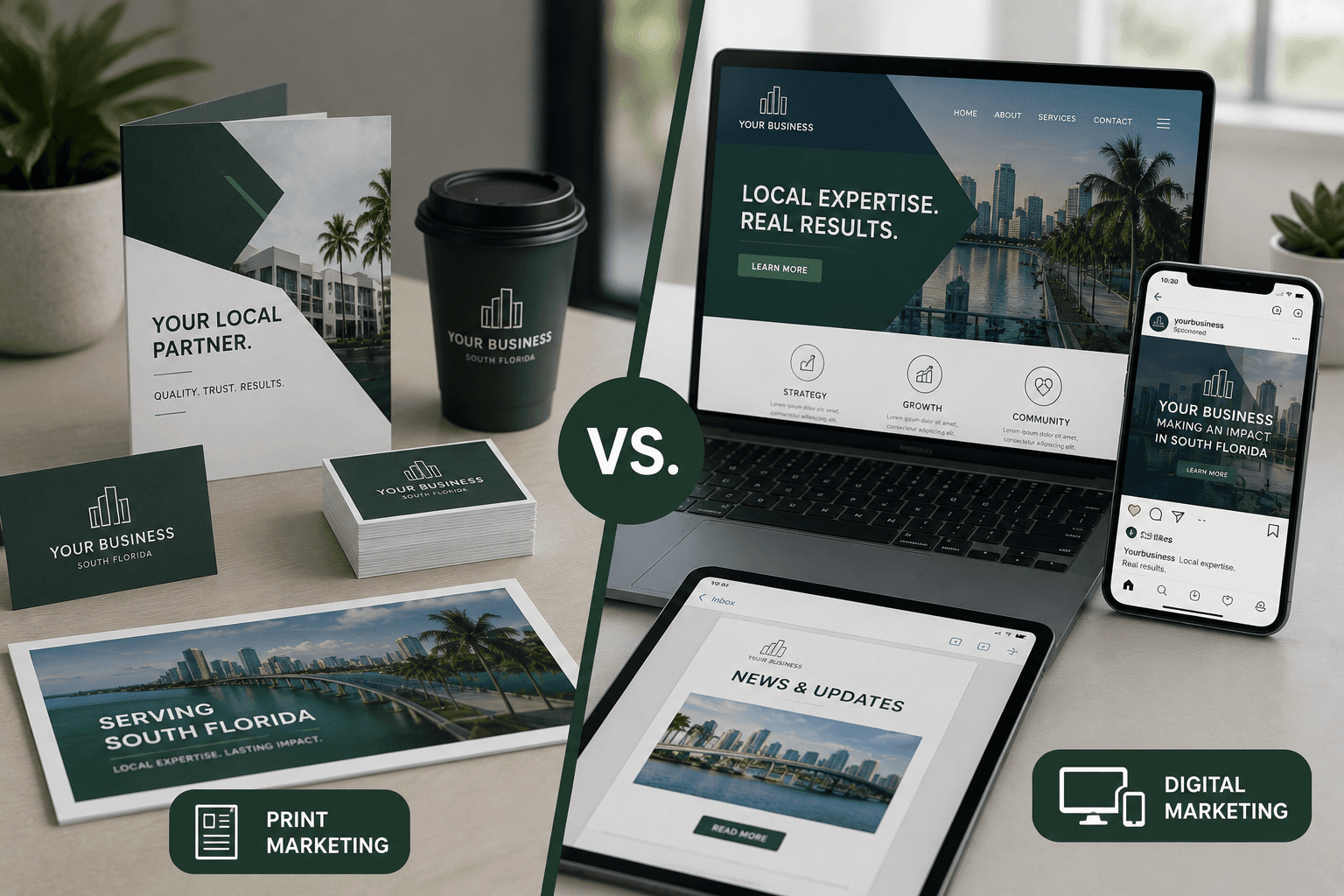
The most important insight from the 2026 marketing data isn't that print beats digital or that digital beats print. It's that the combination of both dramatically outperforms either channel alone.
According to research on multichannel marketing performance, integrated campaigns combining print and digital:
Increase response rates by 40–63% compared to single-channel campaigns
Can boost sales by 400%+ compared to digital-only campaigns
Generate 3–5x higher response rates than single-channel approaches
97% of marketers say integrating direct mail with digital has a positive impact on performance
Campaigns with both print and digital are 400% more effective than digital alone according to USPS research
The reason is straightforward: print and digital work on different cognitive pathways. Print builds trust, creates physical presence, and generates attention. Digital enables immediate response, retargeting, and conversion tracking. When a prospect receives a well-designed postcard and then sees a retargeted digital ad from the same brand two days later — the combined effect is greater than either touchpoint could achieve independently.
A Real-World Example That Shows How It Works A multichannel campaign example from AIIM: an insurance broker targeting high-value prospects ran a 4-week sequence — direct mail introduction in Week 1, email with a personalized quote tool in Week 2, retargeting ads in Week 3, and a final direct mail piece in Week 4. The result: an 8.2% conversion rate versus 1.1% for email-only campaigns — a 7x improvement. The print pieces did the trust-building work. The digital pieces enabled the response and conversion. |
How to Decide What's Right for Your South Florida Business
The channel mix that works best depends on your specific business goals, your target audience, and your budget. Here's a practical framework:
Marketing Goal | Best Channel | Why |
Local customer acquisition | Direct mail + Google Local | Physical presence + local search visibility |
Brand awareness at scale | Social media + print advertising | Broad reach online, credibility offline |
High-value B2B prospect outreach | Direct mail + email sequence | Physical mail opens the door, email follows up |
Patient / customer reactivation | Variable data direct mail | Personalized physical mail to lapsed customers |
Time-sensitive offer or flash sale | Email + social media | Instant delivery, immediate action |
Trade show or event promotion | Print materials + social media | On-site credibility + pre-event digital reach |
Neighborhood / territory saturation | EDDM direct mail | Every address, lowest cost per household |
Long-term organic lead generation | SEO + content marketing | Compounding traffic, zero ongoing cost per click |
What This Means for South Florida Businesses Specifically
The general marketing data makes a strong case for print — but the South Florida market has specific characteristics that make print even more compelling here than in most other US markets.
South Florida's Direct Mail Market Is Underserved by Local Competitors
Most South Florida small and mid-size businesses have followed the conventional wisdom and concentrated their marketing spend on digital. That means the physical mailbox in Miami, Fort Lauderdale, Boca Raton, and Broward County is significantly less crowded than the digital feed. A well-designed postcard landing in a Coral Springs mailbox competes with a handful of other mail pieces — not 4,000 digital ads. The contrast effect alone increases its impact.
The New Resident Opportunity Is Uniquely Powerful Here
South Florida's population mobility is extraordinary — nearly 20,000 new out-of-state driver's license exchanges in just the first quarter of 2026. Every one of those new residents is actively searching for a new doctor, dentist, restaurant, home service provider, and a dozen other local businesses. A direct mail piece arriving in the first 30–60 days after a move is the highest-response campaign any local business can run — and it's a South Florida opportunity that digital campaigns can't replicate with the same precision.
The Tourism and Event Economy Creates Constant Print Demand
South Florida's year-round tourism, convention circuit, and event economy creates a consistent demand for high-quality print materials — trade show displays, event programs, branded collateral, directional signage — that digital simply cannot replace. The Miami Beach Convention Center, Broward County Convention Center, and the region's hospitality infrastructure run on print. That's not going to change.
The Luxury and High-End Market Expects Premium Print
For businesses serving South Florida's luxury residential market, high-end hospitality sector, or premium professional services — print quality is a brand signal. A soft-touch laminated brochure, a premium direct mail package, or a well-produced property listing presentation communicates a level of investment and quality that a digital ad cannot convey. In markets where the average home sale in Boca Raton exceeds $900,000, the marketing materials need to match the price point.
The Practical Takeaway for 2026
If you're a South Florida business running exclusively digital marketing, you are almost certainly leaving significant response rate and ROI on the table. The data is unambiguous: adding print — especially direct mail — to your marketing mix will improve your overall campaign performance, often dramatically.
If you're running exclusively print, you're missing the speed, scale, and retargeting capabilities that digital provides — particularly for time-sensitive communications and broad awareness.
The businesses that will win in South Florida's competitive market over the next three to five years are the ones that stop asking "print or digital?" and start asking "how do we make print and digital work together?" That integration — a direct mail piece that drives to a landing page, a postcard with a QR code that triggers a retargeting sequence, a trade show banner that reinforces the social campaign — is where the 400% performance lift lives.
The Bottom Line on Print vs. Digital in 2026 Direct mail ROI: 161% vs. email 44%, paid search 23%, paid social 21% Direct mail response rate: 4.4% vs. email 0.12% — 37x more effective Combined print + digital campaigns: up to 400% more effective than digital alone 87% of marketers plan to maintain or increase direct mail investment in 2026 Sources: ANA/DMA Response Rate Report, Lob State of Direct Mail, PostcardMania, USPS |
MOR Printing: South Florida's Commercial Print Partner Since 1988
At MOR Printing, we've been helping South Florida businesses produce the print side of their marketing for over 36 years — from direct mail campaigns and trade show materials to branded packaging and promotional products. We're not here to tell you to abandon digital. We're here to make sure print is working as hard as it should be in your marketing mix.
From our 60,000-square-foot facility in Plantation, we produce every print format that South Florida businesses need: postcards and direct mail, brochures and presentation folders, banners and signage, custom packaging, promotional products, and more — with the turnaround times and quality standards that commercial accounts depend on.
Get a free quote at morprinting.com — and let's talk about how print can strengthen the marketing strategy you already have.


