Publish Date
Social Handle


Most businesses think about printing and logistics as two separate problems. They work with a printer to produce materials, then figure out separately how to store them, distribute them across locations, and make sure the right pieces get to the right place at the right time. For a single-location business, that approach works well enough. For multi-location operations — franchise groups, regional retailers, hotel management companies, healthcare networks, financial services firms with branch offices across Broward, Miami-Dade, and Palm Beach — it breaks down fast.
Storage takes up office space. Shipping becomes a recurring operational task. Locations order too much of one thing and run out of another. Materials arrive damaged because they were stored improperly in a humid Florida warehouse. A new location opens and someone has to scramble to pull together a complete print kit in two weeks. These aren't fringe problems — they're the daily reality for any organization managing branded print materials across more than a handful of locations.
Print fulfillment and warehousing is the service that eliminates all of it. This post explains what the service actually covers, which types of organizations get the most value from it, and how MOR Printing's fulfillment program works for commercial accounts in South Florida.
What Print Fulfillment and Warehousing Actually Means
The term gets used loosely, so it's worth being precise. Print fulfillment and warehousing means your printer doesn't just produce your materials — they store them, manage inventory levels, and ship individual orders to your locations, your employees, or your customers on demand. The best programs combine this with a web-to-print ordering portal so authorized users at any location can order what they need without going through a central procurement process.
In practice, this means an operations director in Plantation doesn't have to field calls from twenty franchise locations asking for brochures. It means a hotel chain's front desk manager in Fort Lauderdale can log in, order a set of welcome packets for an upcoming VIP block, and have them arrive in three days. It means a regional bank with branches across South Florida doesn't have to store six months of direct mail inventory in their branch back offices.
The components vary by program, but a complete print fulfillment and warehousing service for commercial accounts covers these core functions:
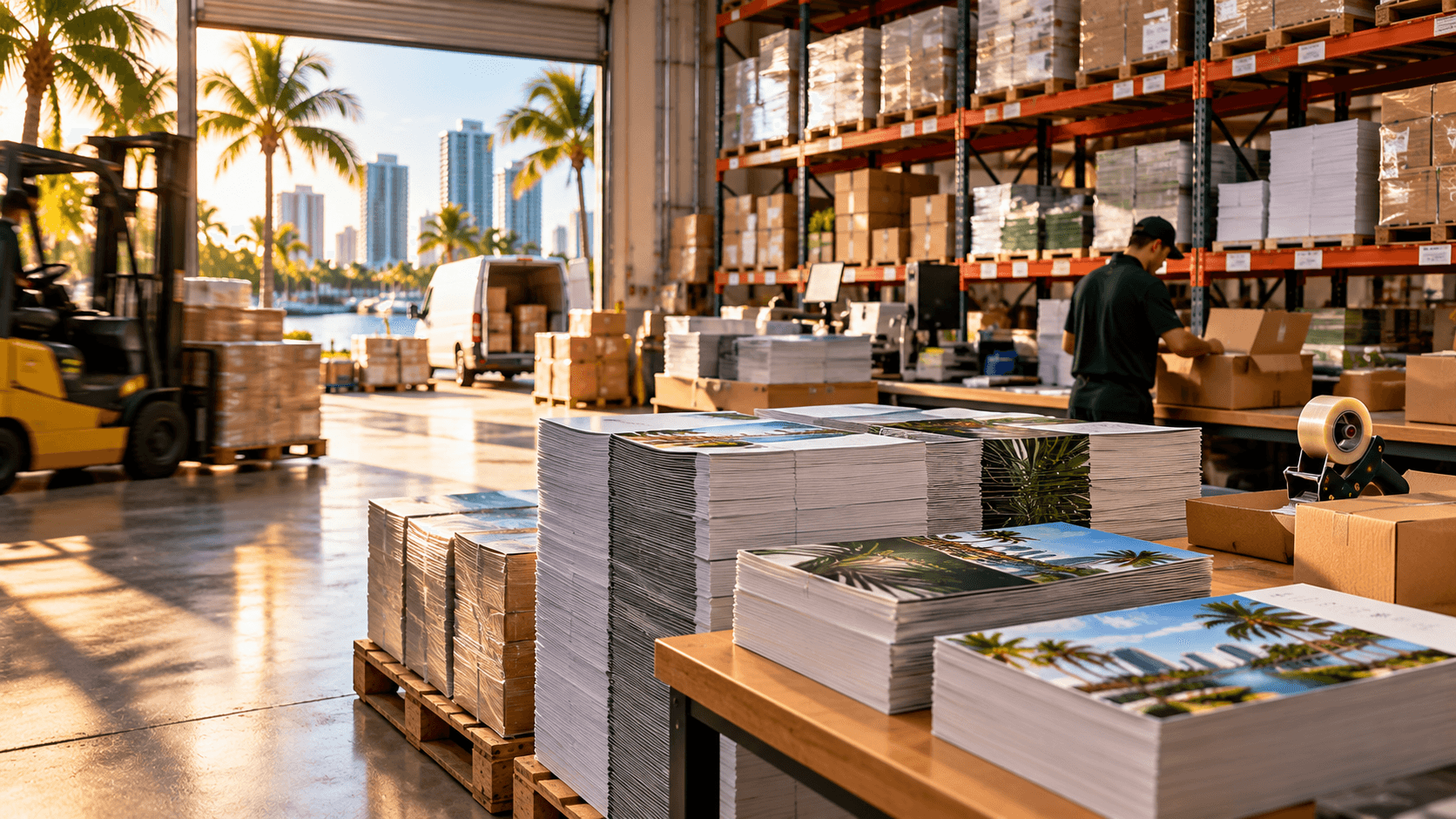
Inventory storage: printed materials held in a climate-controlled facility, tracked by SKU
Pick-and-pack fulfillment: individual orders pulled from inventory, assembled, packaged, and shipped
Direct-to-recipient shipping: orders go straight to the end location without routing through a central office
Web-to-print ordering: an online portal where authorized users place orders against pre-approved, brand-consistent templates
Kitting and assembly: pre-built bundles (new franchise kits, trade show packages, seasonal promotion packs) assembled in-house
Inventory reporting: real-time stock visibility and automatic reorder alerts so materials don't run out before they're needed
Which Organizations Need Print Fulfillment in South Florida
Franchise and Multi-Location Retail Brands
South Florida has one of the densest concentrations of franchise operations in the country, particularly in the food and beverage, fitness, healthcare services, and financial services sectors. Any franchise system with more than five locations faces the same challenge: brand consistency across materials produced and distributed by people who may have different vendors, different standards, and different ideas about what the brand should look like in print.
A centralized print fulfillment program solves this by removing the decision entirely. Locations don't source their own print — they order from an approved catalog of brand-consistent materials through a web-to-print portal. The franchisor controls what's available. The printer produces, stores, and ships. Brand standards are enforced at the source, not by policing what individual locations buy from local print shops.
Hotel and Resort Management Companies
Hospitality groups managing multiple properties across the tri-county area run print-heavy operations — guest communications, event materials, food and beverage menus, conference packages, marketing collateral for sales teams. These materials change frequently (seasonal menus, event-specific programs, updated pricing), which means constant reprints and regular distribution to multiple properties.
A fulfillment program lets hospitality management teams print short runs when materials need to change, store the inventory at a central facility rather than at each property, and ship to individual properties as needed. Properties order what they need when they need it, without tying up storage space in the back office or dealing with overstock of materials that are already outdated.
Healthcare Networks and Medical Practices
Healthcare is one of the fastest-growing sectors in South Florida, and healthcare organizations run some of the most print-intensive operations in any industry — patient intake forms, brochures, referral pads, compliance materials, appointment cards, and a long tail of clinical and administrative forms that vary by specialty and location. Healthcare organizations also face strict brand and compliance requirements that make local sourcing risky.
Print fulfillment for healthcare accounts means centralized production of compliant materials, storage, and distribution to individual clinic locations, physician offices, or urgent care centers across the region. When a compliance requirement changes a form, the update happens once at the source — not in twenty different conversations with twenty different local vendors.
Corporate Accounts With Remote Teams or Branch Networks
South Florida has seen significant corporate relocation activity over the past several years — financial services firms, insurance companies, technology companies, and professional services organizations establishing Southeast headquarters or satellite offices across Miami-Dade, Broward, and Palm Beach. These organizations typically have marketing and brand standards set at a national or regional level but need to distribute materials to local offices, sales teams, and client-facing staff.
Print fulfillment handles the gap. Sales kits, presentation folders, proposal covers, business cards, and branded stationery are produced centrally and shipped directly to individual employees or offices on demand. The brand team doesn't have to manage individual orders. The local office doesn't have to find its own printer.
MOR Printing's Fulfillment and Warehousing Service
MOR Printing's fulfillment and warehousing program is built for commercial accounts — organizations that have real volume, real brand requirements, and real operational stakes in getting their print program right. It is not a side service or an afterthought. It is a core capability that integrates with MOR's full-service commercial printing operation, including offset printing on one of the largest sheet-fed presses in the Southeast, digital short-run production, wide-format, and direct mail.
For commercial accounts in South Florida, the service operates from MOR's facility in Plantation — centrally located to serve Broward, Miami-Dade, and Palm Beach counties, with national shipping for accounts with locations outside the region.
The program covers:
Climate-controlled storage: Florida's heat and humidity degrade print materials in standard warehouse conditions. MOR's storage is climate-controlled, which matters for anything with laminate, specialty coatings, or pressure-sensitive adhesives.
Web-to-print storefront: Authorized users at any location log into a branded portal, see the catalog of approved materials, and place orders that flow directly into fulfillment. No phone calls, no emails to a central office, no risk of someone ordering the wrong version of a piece.
Custom kitting: New location opening kits, grand opening packages, trade show bundles, and seasonal promotion kits assembled in-house and shipped complete.
Variable data production: For materials that need location-specific information — address, phone number, store hours, local manager name — MOR produces variable data runs and manages them as part of the inventory program.
Inventory reporting: Real-time stock visibility through the web-to-print portal, with configurable reorder thresholds so the account team always knows what's on hand before they need it.
Print Fulfillment Service Overview
The table below summarizes the core services in MOR Printing's fulfillment program and how each one operates for commercial accounts:
Service | Best For | How It Works With Print Fulfillment |
Inventory Storage | Multi-location brands | Print materials stored in our climate-controlled facility, ready to ship on demand without minimum orders |
Pick-and-Pack Fulfillment | Marketing kits, onboarding packs | Custom orders pulled from inventory and assembled per job — promotional bundles, franchise welcome kits, event packages |
Direct-to-Recipient Shipping | National brands, remote teams | Materials ship directly to individual locations, employees, or customers — no routing through a central office |
Web-to-Print Storefront | Franchises, multi-location retailers | Branded online portal where authorized users order pre-approved print pieces; orders flow straight to fulfillment |
Campaign Management | Seasonal promotions, grand openings | Coordinate timed print releases across locations — all materials arrive on-site when they're needed, not before |
Kitting and Assembly | Trade show packs, onboarding kits | Pre-packaged bundles assembled in-house and shipped complete — reduces labor at the receiving location |
Inventory Reporting | Operations and procurement teams | Real-time visibility into stock levels; reorder triggers so materials never run out before a campaign or event |
What Separates a Print Fulfillment Partner From a Print Vendor
The distinction matters because the operational relationship is fundamentally different. A print vendor produces an order and ships it. A print fulfillment partner is part of your supply chain — they hold your inventory, they manage reorder cycles, they connect their production workflow to your ordering system, and they're accountable for materials being in stock and on time not just when you place an order but on an ongoing basis.
For commercial accounts in South Florida, the right questions to ask when evaluating a fulfillment partner include:
How is inventory stored? Climate control is non-negotiable in South Florida. Standard commercial storage in this market is not adequate for print materials with coatings or pressure-sensitive elements.
Is the web-to-print portal branded to our organization? A generic ordering interface creates friction and confusion at the location level. The portal should look like your brand and surface only the materials your locations are authorized to order.
Can you produce and fulfill variable data materials? Location-specific content — address, phone, manager name — is a requirement for most multi-location programs, not an edge case.
What is your turnaround from order to ship? For on-demand fulfillment to work operationally, the turnaround from a location placing an order to the materials leaving the facility needs to be fast — typically 24 to 48 hours for in-stock items.
How do you handle inventory alerts and reorders? A reactive reorder process creates stockouts. A proactive program sets minimum thresholds and alerts the account team — or triggers automatic reorders — before stock runs out.
What reporting does the account team receive? Visibility into what's being ordered by which locations, at what velocity, is the data that lets marketing and operations teams manage the program intelligently over time.
How Print Fulfillment Connects to Direct Mail
For accounts that run direct mail campaigns in addition to managing brand collateral — and in South Florida, most commercial accounts with a significant local market presence do — fulfillment and direct mail can operate as an integrated program.
Rather than treating direct mail as a separate print job that goes out once, an integrated program stores the mailing pieces as inventory, segments the list by geography or customer type, and releases batches on a schedule — a monthly promotion, a quarterly check-in, a triggered campaign when a prospect hits a certain threshold in a CRM. The fulfillment infrastructure that stores your brochures is the same infrastructure that stages your direct mail.
MOR Printing's direct mail capabilities include EDDM (Every Door Direct Mail) for neighborhood saturation campaigns, targeted list mail with variable data, and complete mailing services through the direct mail platform. For commercial accounts in South Florida that want their print program to include both brand collateral and outbound marketing, integrating both under one fulfillment partner simplifies operations and typically reduces per-piece cost by eliminating redundant production and shipping steps.
For more on MOR's direct mail program, see the South Florida direct mail services page on morprinting.com.
Getting a Print Fulfillment Program Started
Setting up a print fulfillment program with MOR Printing starts with a conversation about your current print volume, how many locations or distribution points you're managing, what your brand control requirements look like, and what your ordering workflow currently is. From there, the team structures a program around your actual operation — not a generic template.
For accounts transitioning from multiple vendors to a centralized fulfillment program, MOR handles the transition — auditing current materials, recommending consolidations, onboarding the web-to-print catalog, and setting up the initial inventory. The goal is to get the program operational without disrupting active campaigns or leaving any location without materials during the transition.
The minimum to start is typically a defined catalog of materials (even if that's five items to start), an identified set of locations or distribution points, and a baseline order volume that makes inventory storage cost-effective. For most commercial accounts, a conversation takes 30 minutes and produces a clear picture of what the program should look like.
Frequently Asked Questions About Print Fulfillment in South Florida
Is there a minimum volume requirement to use the fulfillment and warehousing service?
MOR Printing's fulfillment program is designed for commercial accounts with ongoing print volume — typically organizations with multiple locations or regular distribution requirements. There is no single universal minimum, but the service is most cost-effective for accounts spending at least $25,000 to $30,000 annually on print across their organization. The right way to assess fit is a direct conversation with the MOR account team.
How does climate-controlled storage differ from standard warehousing?
South Florida's heat and humidity accelerate the degradation of print materials — particularly laminated pieces, specialty-coated stocks, and anything with pressure-sensitive adhesives. Climate-controlled storage maintains temperature and humidity within ranges that prevent warping, peeling, and coating failure. For any commercial account storing materials for more than 30 days in South Florida, climate-controlled storage is a requirement, not an upgrade.
Can the web-to-print portal be branded with our company's name and logo?
Yes. MOR Printing's web-to-print storefront is set up as a branded portal for each commercial account — your logo, your color scheme, your catalog of approved materials. Users at individual locations see a portal that looks like your brand, not a generic print ordering interface. Access can be managed by location, by role, or by material type depending on your organizational structure.
What happens if a material needs to be updated — does all the existing inventory become obsolete?
This is one of the most important operational questions for any fulfillment program. MOR's approach is to set inventory levels for materials that change frequently at shorter cycles — shorter print runs, more frequent reorders — so that when a change is needed, existing inventory is minimal. For materials that change on a known schedule (seasonal menus, annual compliance updates), the program is structured to time production runs so that inventory turns over at the right moment. Variable data materials — where the content changes by location — are produced in tighter runs to minimize obsolescence risk.
Do you offer fulfillment for accounts outside of South Florida?
Yes. While MOR Printing's primary commercial market is Broward, Miami-Dade, and Palm Beach counties, the fulfillment and warehousing service ships nationally. For national brands with South Florida headquarters or regional offices, MOR can serve as the fulfillment hub for the entire network.
The Bottom Line for South Florida Commercial Accounts
If your organization is managing more than a handful of locations, coordinating print orders for a distributed team, or running a brand that requires consistency across materials produced and used at multiple points — you already have a fulfillment problem, whether you've named it that way or not.
The question is whether you're solving it in a way that scales. Multiple vendors, local sourcing, central office ordering and redistribution — these approaches work until they don't. They break down when volume grows, when the number of locations increases, when brand standards need to be enforced more tightly, or when a campaign requires coordinated distribution across your entire footprint on a tight timeline.
MOR Printing's fulfillment and warehousing program is built to handle exactly that. Over 36 years serving South Florida's commercial market, from a 60,000-square-foot facility in Plantation equipped with production capabilities that few regional printers can match.
To discuss a fulfillment program for your organization, contact MOR Printing at morprinting.com or call (954) 931-8262. The first conversation is a scoping call — no obligation, no pitch, just a clear picture of what a program for your operation looks like.


