Publish Date
Social Handle


If you've owned a business in South Florida for more than a few years, you already know the story. A new sign goes up looking sharp — bold colors, crisp graphics, professional finish. Then the Miami sun gets to work. Six months later the colors are washed out. A year in and the corners are warping. Two summers of afternoon thunderstorms and the whole thing looks like it was installed in a different decade.
The problem isn't the design. It's the material. Florida is one of the harshest environments for outdoor signage in the entire country — and most business owners don't find that out until they're replacing a sign they expected to last five years after just eighteen months.
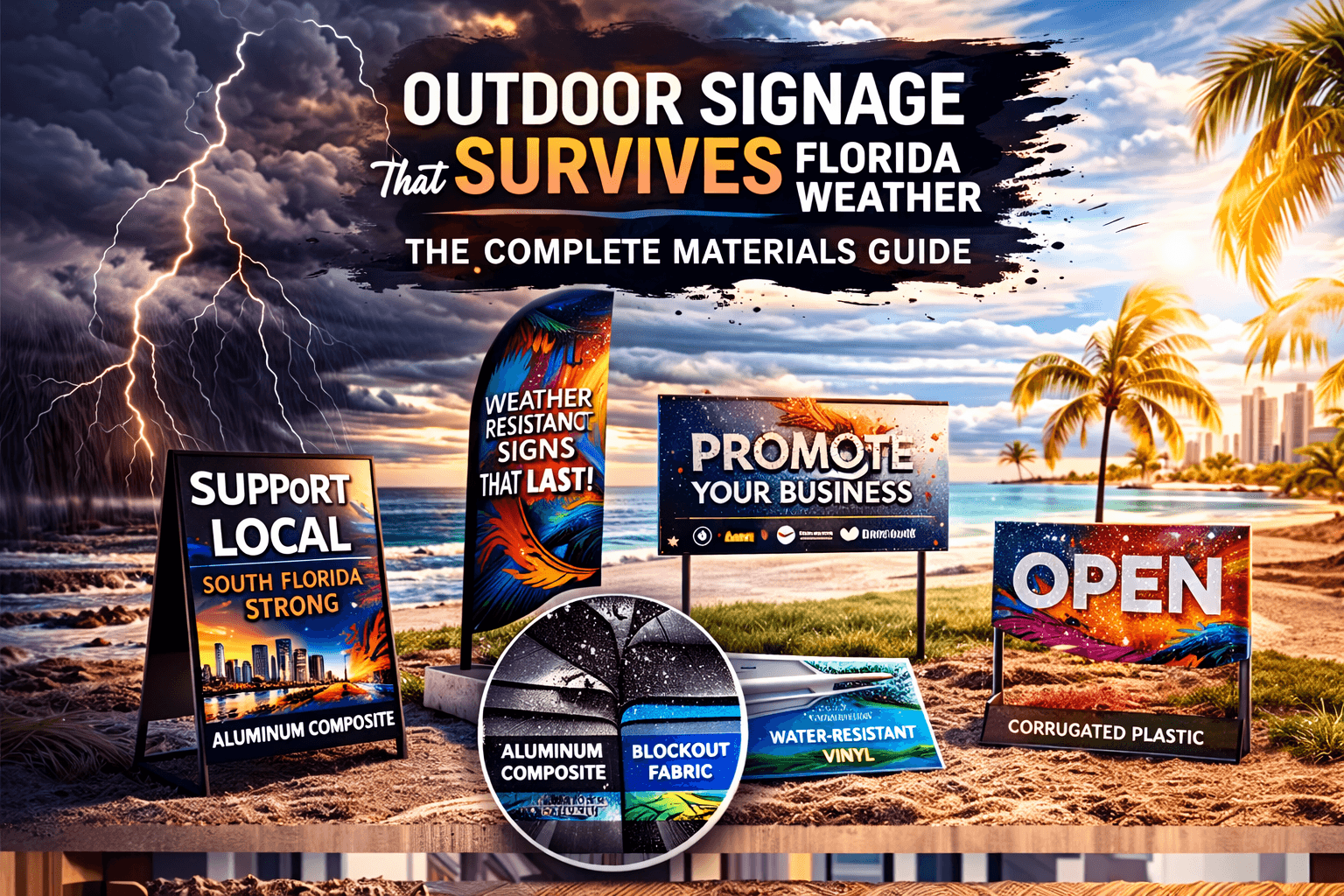
This guide breaks down exactly what South Florida businesses face from a weather standpoint, which materials hold up and which ones fail, and how to make a smart investment in outdoor signage that actually lasts. Whether you're in Miami, Fort Lauderdale, Plantation, Boca Raton, or anywhere across Broward, Miami-Dade, or Palm Beach County — this is what you need to know before your next sign order.
What Florida's Climate Actually Does to Outdoor Signs
Most signage guides talk about weather in vague terms. South Florida businesses need specifics, because our climate creates a perfect storm — literally — of four distinct forces that destroy outdoor signage faster than almost anywhere else in the US.
1. UV Radiation — The Silent Color Killer
South Florida receives among the highest UV index readings in the continental United States. UV rays break down pigments at the molecular level, causing colors to fade, substrates to become brittle, and coatings to crack and peel. This process — called photodegradation — happens whether it's cloudy or clear, and it's relentless year-round. A sign printed with standard inks and no UV-protective coating or laminate will show visible fading within six to twelve months of outdoor exposure in Miami or Fort Lauderdale.
2. Humidity and Daily Moisture Cycles
South Florida's humidity averages above 75% for most of the year. That persistent moisture infiltrates porous materials, weakens adhesives, causes paper-based substrates to swell and warp, and accelerates ink bleed on uncoated surfaces. The daily cycle of morning humidity followed by afternoon heat creates constant expansion and contraction in sign materials — which eventually causes delamination, cracking, and structural failure in less robust substrates.
3. Salt Air (Coastal Corrosion)
For businesses in Miami Beach, Fort Lauderdale Beach, Boca Raton, Deerfield Beach, or anywhere within a few miles of the coast, salt air is a constant threat. Airborne salt accelerates corrosion in metals, degrades adhesives, and discolors vinyl. Standard hardware — screws, mounting brackets, standoffs — can rust and fail within a single season in beachfront environments. Signs that would last a decade inland may need replacement in two to three years at a coastal location if the wrong materials and hardware are used.
4. Hurricane-Force Winds and Storm Season
Miami-Dade and Broward counties sit in Florida's High-Velocity Hurricane Zone (HVHZ) — which means building codes here are among the strictest in the nation. Signage that isn't properly engineered and mounted for wind loads can become a projectile in a tropical storm, posing safety risks and creating serious liability. Hurricane season runs June through November, which means your signs need to be built and mounted for wind resistance every single year.
The Bottom Line on Florida's Climate According to signage industry research, 65% of outdoor signs in Florida need replacement within 2 years due to weather damage — unless they were built with the right materials from the start. The investment in proper materials isn't a luxury. It's the difference between a 2-year sign and a 10-year sign. |
The Best Outdoor Sign Materials for South Florida — Ranked
1. Aluminum — The Gold Standard for Permanence
Aluminum is the undisputed champion for permanent outdoor signage in Florida. It doesn't rust (unlike steel), it's naturally corrosion-resistant even in coastal salt-air environments, and it handles UV exposure, rain, and wind without warping or degrading. According to outdoor sign material experts, aluminum signs generally last 10–15 years outdoors — even in harsh climates like South Florida's. The smooth surface prints beautifully with UV-stable inks and accepts vinyl graphics cleanly.
Best for: Permanent storefront signs, building identification, parking and wayfinding signage, post-mounted signs, real estate and commercial property signage.
2. Dibond (Aluminum Composite Material) — Large Format Done Right
Dibond — also called ACM (aluminum composite material) — is two thin aluminum skins bonded to a polyethylene core. It's about half the weight of solid aluminum, which makes installation easier and reduces structural requirements. The aluminum skins protect the core from UV and moisture while preventing warping even under direct South Florida sun. Dibond signage typically lasts 5–7 years in harsh outdoor climates, and is ideal for large-format graphics where flatness and consistent color are critical.
Best for: Retail storefront fascia panels, architectural signage, large wall graphics, real estate development signs, and any application where premium aesthetics and large size matter.
3. Acrylic — Premium Look with Built-In UV Resistance
Acrylic is 17 times more impact-resistant than glass, naturally UV-resistant, and moisture-proof — making it an excellent choice for South Florida businesses that want a high-end appearance that lasts. As South Florida signage professionals note, acrylic maintains its crisp clarity and resists the corrosive effects of salt air in coastal areas like Miami Beach and Fort Lauderdale. For backlit signs, it's the top material choice — its translucent properties make light transmission dramatic and even.
Best for: Illuminated and backlit signs, lobby and storefront identity signs, dimensional lettering, premium retail and hospitality businesses. For coastal locations, specify marine-grade mounting hardware alongside your acrylic sign.
4. Cast Vinyl — Flexible, Durable, and Versatile
Not all vinyl is created equal. Cast vinyl — the premium grade used for vehicle wraps, architectural window graphics, and long-term outdoor applications — can last 5–8 years outdoors when applied correctly. It conforms to surfaces without bubbling, and high-quality cast vinyl is treated with UV inhibitors that significantly delay photodegradation. Standard calendered vinyl, by contrast, is a short-term material that may last 2–3 years at best in Florida sun. Always specify cast vinyl for any outdoor application intended to last.
Best for: Window graphics, wall murals, vehicle wraps, building wraps, surface-applied storefront graphics.
5. PVC (Foam Board) — Short-Term Use Only in Florida
PVC foam board is lightweight, affordable, and easy to work with — which makes it popular for temporary and promotional signage. The limitation in Florida is that standard PVC becomes brittle and fades under prolonged, intense UV exposure. With a quality UV-protective laminate applied, PVC can last several years outdoors, but it should not be the material of choice for anything expected to perform beyond 1–3 years in a high-sun South Florida environment.
Best for: Short-term promotional signage, real estate yard signs, seasonal displays, construction site signs, event wayfinding.
6. Heavy-Duty Vinyl Banners — Events and Temporary Outdoor Use
A quality heavy-duty vinyl banner (13 oz or higher) with UV-resistant inks and a UV laminate can hold up for 3–5 years outdoors in Florida conditions. The key factors are grommets and wind slits for proper ventilation and secure mounting — an unsecured banner in a South Florida afternoon thunderstorm won't last a season. For event signage, construction fencing, and temporary outdoor promotions, heavy vinyl is excellent value. For anything permanent, move up the materials list.
Best for: Construction site signage, grand opening banners, event displays, temporary outdoor promotions, fence wraps.
Quick Comparison: Outdoor Sign Materials for South Florida
Material | Best For | Lifespan (FL) | UV / Humidity |
Aluminum | Permanent storefronts, parking, wayfinding | 10–15+ years | Excellent |
Dibond (ACM) | Large-format graphics, retail facades | 5–7 years | Excellent |
Acrylic | Backlit signs, premium aesthetics | 5–10 years | Very Good |
Cast Vinyl | Window graphics, vehicle wraps, walls | 5–8 years | Very Good |
PVC (foam board) | Short-term promo, seasonal signage | 1–3 years | Moderate (needs UV coat) |
Vinyl Banner (heavy) | Events, construction, temp outdoor display | 3–5 years | Good (with UV laminate) |
The Coatings and Finishes That Make the Real Difference
The substrate is only half the equation. In South Florida, what goes on top of your printed sign matters as much as what it's printed on. These protective treatments are the difference between a sign that fades and one that doesn't.
UV Laminate
A UV-protective laminate applied over printed graphics is the single most impactful upgrade for any outdoor sign in Florida. It creates a clear barrier against UV radiation, moisture penetration, and surface abrasion. Available in gloss, matte, and satin finishes — and it adds a premium, finished look to any printed piece in addition to dramatically extending lifespan.
UV-Stable Inks
Not all printing inks are created equal outdoors. UV-stable or outdoor-rated inks are formulated to resist photodegradation far longer than standard CMYK inks. When paired with a UV laminate, the combination provides the most robust color protection available for printed signage in high-UV environments like South Florida.
Marine-Grade Hardware for Coastal Locations
For any business within a few miles of the coast — Miami Beach, Hallandale Beach, Boca Raton, Dania Beach — mounting hardware deserves as much attention as the sign material itself. Standard steel screws and brackets can rust and fail within a single season of salt-air exposure. Specify marine-grade stainless steel hardware for all coastal installations.
Hurricane Season: What South Florida Businesses Need to Know About Sign Safety
Hurricane season runs from June 1 through November 30 — and if your signage isn't properly rated and mounted, it can become a serious safety hazard during a tropical storm or hurricane. Here's what matters:
Wind-load engineering: Commercial outdoor signs in South Florida should be designed and installed to meet Florida Building Code Chapter 16 wind-load requirements. Miami-Dade and Broward County fall in the HVHZ — the strictest wind-rating zone in the US.
ASTM E330 compliance: For permanent mounted signage, look for ASTM E330 testing certification, which verifies the sign's ability to resist uniform wind pressure.
Fabric displays over rigid panels: For temporary outdoor signage during storm season, fabric SEG displays are significantly safer than rigid vinyl or foam board — they flex in wind rather than becoming projectiles.
Pre-season inspection: A twice-yearly inspection of all mounted exterior signage — before and after hurricane season — catches loose hardware, weathered coatings, and mounting failures before they become problems during a storm.
When to Bring Signs Inside Retractable banner stands, A-frame sidewalk signs, and lightweight foam board signs should always be brought indoors when a tropical storm or hurricane watch is issued. These materials are not rated for wind loads — and in a storm, they can cause property damage or injury. |
How to Make Your Outdoor Signage Last Longer in South Florida
Even the best materials benefit from smart care. These practices extend the lifespan of any outdoor sign in Florida's climate:
Always specify UV laminate on any printed outdoor sign — no exceptions in South Florida.
Use outdoor-rated inks — confirm with your printer that outdoor UV-stable inks are being used for any exterior application.
Choose marine-grade hardware for any coastal location within a few miles of saltwater.
Inspect twice yearly — before June 1 (hurricane season start) and after November 30 (hurricane season end).
Clean regularly — South Florida's combination of humidity, salt air, and algae growth creates surface buildup that accelerates substrate degradation. A simple soap-and-water wash every few months keeps signs looking sharp and protects coatings.
Budget for replacement cycles — even the best outdoor signs don't last forever in Florida. A 5-year replacement budget for aluminum and a 2–3 year budget for PVC and vinyl is realistic planning, not pessimism.
Get Outdoor Signage Built for Florida — From a Printer That Knows the Climate
At MOR Printing, we've been producing outdoor signage for South Florida businesses for over 36 years. We know what works in Miami's heat. We know what survives Fort Lauderdale's salt air. We know what holds up through another Broward County hurricane season — because we've seen every material perform and fail in this climate firsthand.
From aluminum and Dibond storefront signs to UV-laminated banners, cast vinyl graphics, and wide-format outdoor displays, we produce everything in-house at our 60,000-square-foot Plantation facility — with the material expertise to match the right substrate and finish to your specific location, use case, and budget.
Don't replace the same sign twice. Get a free quote at morprinting.com and let's build outdoor signage that's made to last in South Florida.


